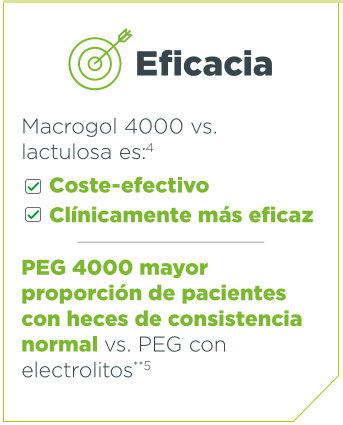
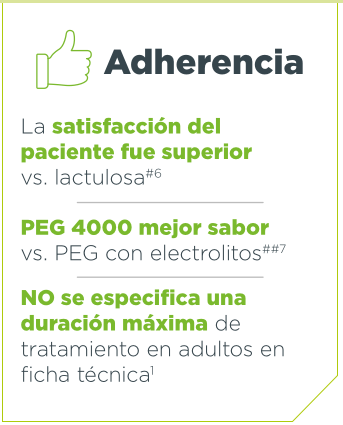
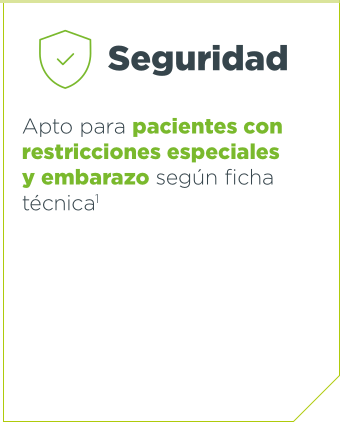
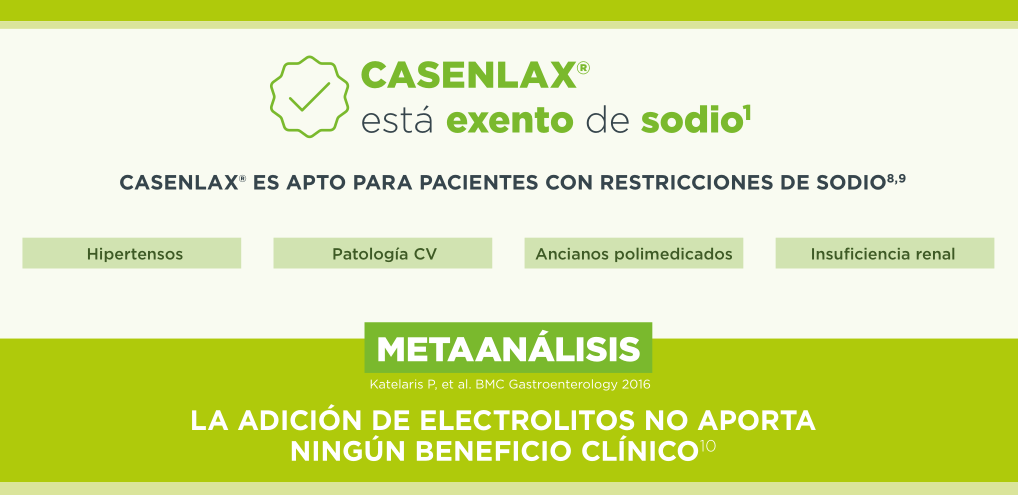
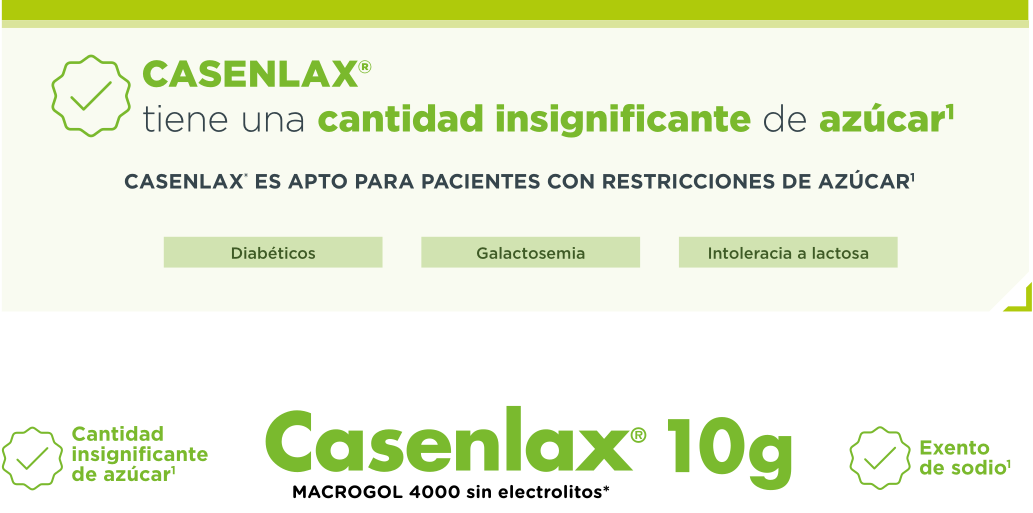
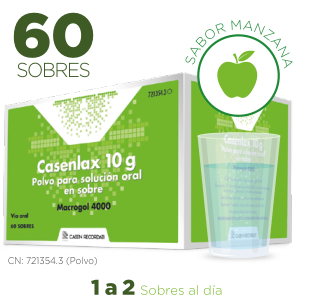
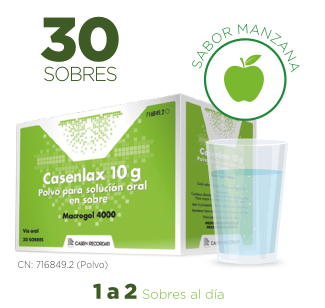
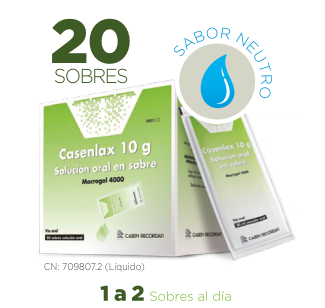
*Como parte del principio activo. **Estadísticamente significativa vs. PEG con electrolitos. #Con PEG 4000 vs. lactulosa. ##Mejor aceptado por su sabor vs. PEG con electrolitos. Esto es especialmente importante en ancianos que requieren tratamientos largos y así mejora la adherencia al tratamiento.
^En relación a la duración de la presentación (cantidad de sobres por caja y menor coste al paciente en relación al tratamiento día).
Referencias : 1. Fichas técnicas de Casenlax® 10g Polvo y Casenlax® 10g Solución oral. 2. Tytgat GN, Heading RC, Müller-Lissner S, et al. Contemporary understanding and management of reflux and constipation in the general population and pregnancy: a consensus meeting. Aliment Pharmacol Ther. 2003;18(3):291-301. 3. De Giorgio R, Cestari R, Corinaldesi R, et al. Use of Macrogol 4000 in chronic constipation. European Review for Medical and Pharmacological Sciences 2011; 15:960-966. 4. Guest JF, Clegg JP, Helter MT. Cost-effectiveness of macrogol 4000 compared to lactulose in the treatment of chronic functional constipation in the UK. Curr Med Res Opin. 2008;24(7):1841-1852. 5. Seinelä L, Sairanen U, Laine T, et al. Comparison of polyethylene glycol with and without electrolytes in the treatment of constipation in elderly institutionalized patients: a randomized, double-blind, parallel-group study. Drugs Aging. 2009;26(8):703-13. 6. Lyseng‑Williamson. Macrogol (polyethylene glycol) 4000 without electrolytes in the symptomatic treatment of chronic constipation: a profile of its use. Drugs & Therapy Perspectives. 2018;34:300–310. 7. Szojda MM, et al. Differences in taste between two polyethylene glycol preparations. J Gastrointest Liver Dis 2007;16(4):379-81. 8. Wei L, Mackenzie IS, MacDonald TM, et al. Cardiovascular risk associated with sodium-containing medicines. Expert Opin Drug Saf. 2014;13(11):1515-23. 9. Navarro Ruiz MS, Llanos Val Jiménez C, García Atienza E, et al. Frecuencia de estreñimiento en pacientes de Atención Primaria. Rev Clin Med Fam. 2015 Feb 8(1):4-10. 10. Katelaris P, Naganathan V, Liu K, et al. Comparison of the effectivenes of polyethylene glycol with and without electrolytes in constipation: a systematic review and network meta-analysis. BMC Gastroenterology. 2016;16:48.